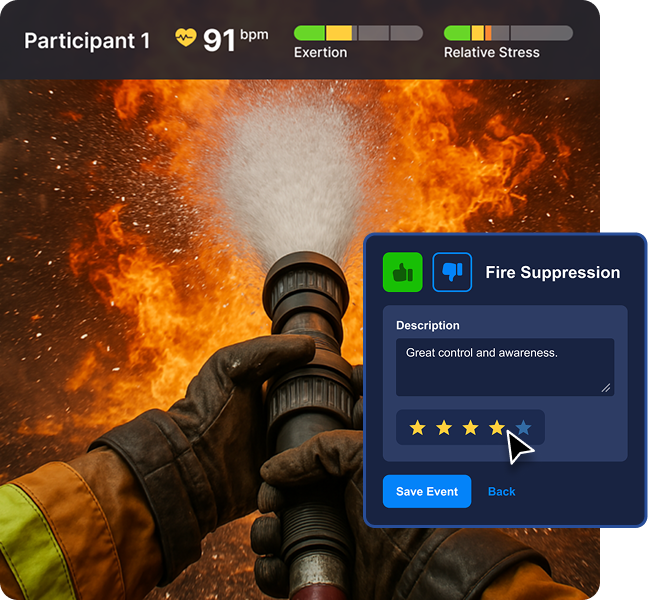
In mission-critical environments, training does not end when the exercise concludes.
The moments after a scenario—when participants reflect and review performance—are often where the most meaningful learning occurs. Traditionally, this process is guided by instructors.
As training scales across teams and locations, relying solely on instructor-led review becomes difficult to sustain.
The challenge is not reducing instructor involvement, but extending learning beyond it.
The Limits of Instructor-Led Review
Instructors are central to effective training. Period.
Their ability to interpret performance and guide improvement is essential, and usually built on many years of hard-fought experience.
However, instructor time is as invaluable as limited.
Across distributed programs, not every participant receives the same depth of feedback. Debriefs must balance time, group dynamics, and multiple perspectives, which can limit how deeply individual performance is explored.
As a result, some learning opportunities are missed.
Shifting Toward Self-Review
To address this, training environments are beginning to incorporate structured self-review.
When participants can revisit their own performance, learning becomes more continuous. Individuals can reflect on their actions, identify patterns, and recognize areas for improvement without waiting for instructor input.
This does not replace the instructor. It extends the learning process beyond the scheduled debrief.
Structuring After-Action Review
Self-review is most effective when it is structured.
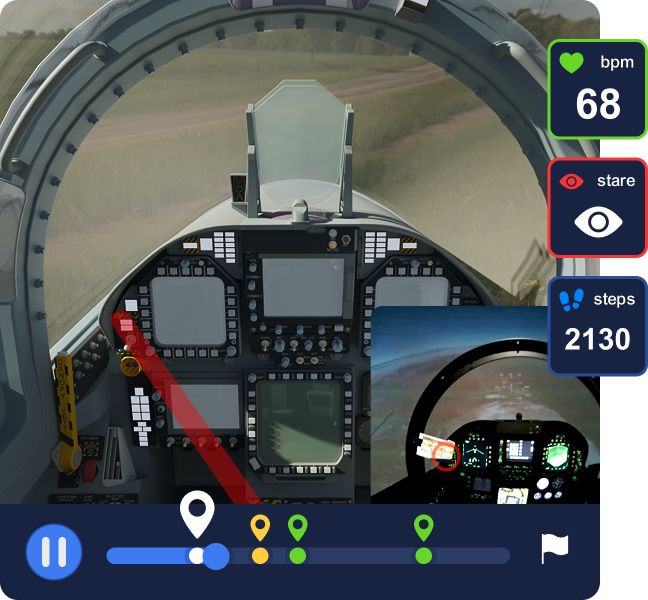
With BioTwin®, training sessions can be revisited through After Action Review (AAR), where first-person perspective, gaze behaviour, and event timing are aligned within a single timeline.
This allows participants to examine how their actions unfolded during the scenario—moving beyond recollection to direct observation.
Building Behavioural Awareness
Structured review strengthens behavioural awareness.
Participants begin to understand how attention, timing, and sequencing influence performance. Subtle patterns become easier to recognize when viewed in context.
Over time, this improves individual accountability and accelerates skill development.
Reusable Learning Across Sessions
Autonomous learning becomes more valuable when it can be repeated.
With BioTwin®, structured scenarios can be reused across sessions through tools such as BioTwin® Hyper VR, allowing participants to engage with consistent training environments and review their performance over time.
This creates continuity without increasing instructor workload.
Balancing Autonomy and Oversight
Autonomous learning does not mean removing oversight.
Instructors remain essential in guiding performance and validating outcomes. What changes is how their time is used.
When participants arrive at debriefs with greater awareness, instructors can focus on higher-value guidance rather than reconstructing events.
Extending Learning Beyond the Session
Training effectiveness is shaped not only by what happens during an exercise, but by how well participants understand their performance afterward.
By enabling structured self-review and reusable training workflows, organizations can extend learning beyond the session without increasing instructor burden.
In mission-critical environments, this balance is essential.
Because the goal is not just to complete training—but to ensure learning continues after it ends.