Memory Is Not Evidence
Most after-action reviews begin the same way.
A team gathers after an exercise, inspection, incident, or training event and starts discussing what happened. Participants share observations, compare perspectives, and attempt to reconstruct key decisions.
There is one problem - human memory is unreliable.
People remember events differently. Critical details are forgotten. Timelines become compressed. Actions that felt obvious in the moment become difficult to explain afterward.
The result is that many debriefs rely more on narrative than evidence.
The Limits of Traditional Debriefs
Traditional after-action reviews serve an important purpose. They encourage reflection, discussion, and knowledge sharing.
However, they are often built around what people remember rather than what actually occurred.
Two team members can leave the same event with completely different interpretations. One may believe a decision was made early, while another remembers it happening much later. One person may recall noticing a hazard immediately, while another may not remember seeing it at all.
Neither perspective is necessarily wrong, they are simply incomplete.
Without objective evidence, organizations are often left trying to understand performance through recollection alone.
The Shift Toward Evidence-Based Review
The future of after-action review is moving beyond discussion and toward objective reconstruction.
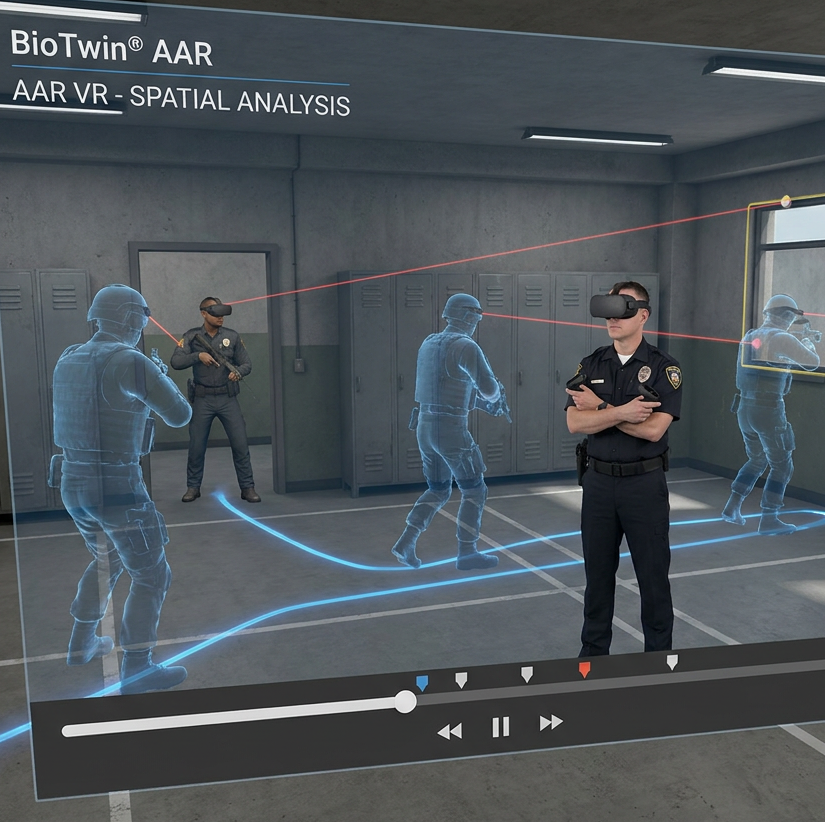
Replay systems allow teams to revisit events through synchronized timelines rather than relying solely on recollection. Instead of debating what happened, participants can examine the sequence of events directly.
Discussions become less about opinions and more about understanding. Teams spend less time reconstructing events and more time identifying opportunities for improvement.
The focus shifts from memory to evidence.
How BioTwin® Helps
BioTwin® supports a more objective approach to after-action review.
By synchronizing first-person video, gaze behavior, event markers, and optional biometric data, BioTwin® creates a replayable record of performance during training and assessment activities.
During review, instructors and teams can revisit critical moments, examine decision timelines, and better understand how attention, actions, and events aligned throughout a scenario.
This also enables a deeper understanding of team synchronization. Evaluators can see how individuals responded to the same event, how information flowed through the group, and where coordination was strong or delayed.
Instead of relying solely on what people remember, teams can review what actually happened.
Better Reviews Create Better Performance
After-action reviews are one of the most valuable learning tools organizations have.
But their effectiveness depends on the quality of the information being reviewed.
As operational environments become more complex, relying on memory alone becomes increasingly difficult. Objective replay and reconstruction provide a more accurate foundation for learning, improvement, and readiness.
Because memory is valuable.
But evidence is better.