A Term Stretched Too Far
"Digital twin" may be the most stretched term in training technology.
It now describes a live sensor model of a jet engine, a 3D scan of a building, a city planning simulation, and sometimes a rendering with no live data behind it at all.
When a term can mean anything, it stops telling you much. For training teams comparing tools, the label alone says very little about what a system can actually prove.
The Idea Is Older Than the Name
In April 1970, an oxygen tank exploded aboard Apollo 13. On the ground, NASA engineers combined their simulators with real-time data from the damaged spacecraft to work the problem.
That was the core idea: a model of something real, fed by data from the real thing, used to make better decisions about it.
The name "digital twin" came decades later. The principle has not changed. Industry groups still define a digital twin as a virtual representation of something real, kept in sync with it through data.
Most Twins Model the Asset
In practice, most digital twins model things.
A plant's pipes and valves. A building's systems. An engine's wear over time.
That is valuable work. Asset twins help teams predict failures, plan maintenance, and run complex sites more safely.
But they answer questions about the equipment. Is the valve open? When will this part need replacing?
They rarely account for the person standing next to the valve.
Training Measures People, Not Assets
In training, the asset is not what is being measured. The person is.
An instructor does not need to know whether a door in the training village is open. They need to know whether the operator checked it, from where, and how quickly.
Where was their attention when the scenario changed? Did the team cover every sector, or leave one open?
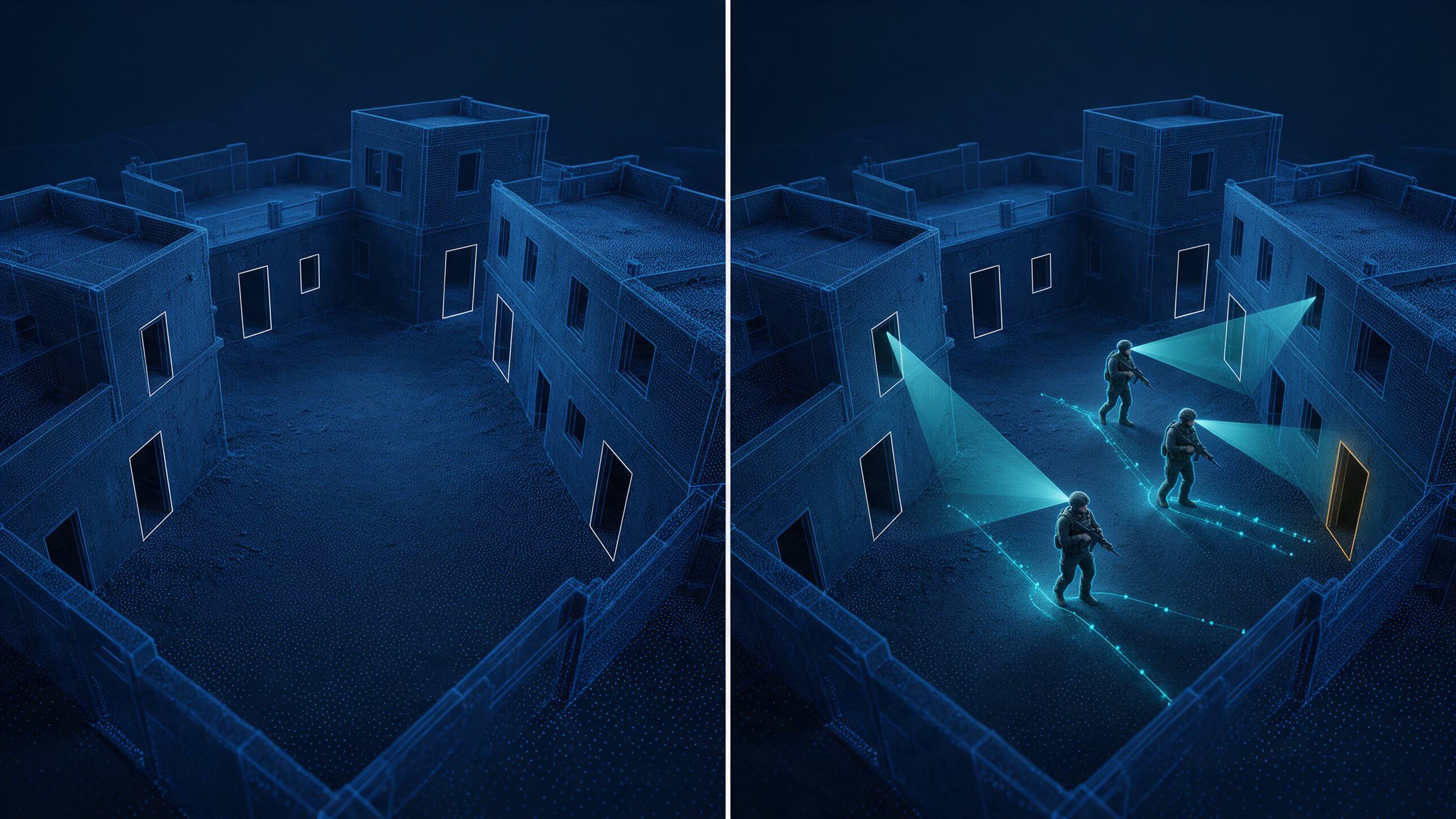
A twin of the environment with no human in it is a map. It is useful, but it is silent on performance.
How BioTwin® Helps
BioTwin® starts the way a good twin should, with the real environment. Before the exercise begins, a drone terrain scan builds a precise digital twin of the actual training space.
Then it adds what most twins leave out. BioTwin® captures where each operator was, what they saw, and how they moved, and maps it inside that twin. This is Spatial Validation.
Instructors can see whether attention went where the environment demanded. Evaluators can review the same moment the same way, without relying on memory.
The result is a twin defined by the people in it. The same spatial record carries across live, virtual, and constructive training, measured against the same ground truth.
Put the Human Back in the Twin
"Digital twin" does not need a new definition. It needs the original one, applied to what training actually cares about.
A model of something real, kept in sync with reality, used to make better decisions. In training, the most important real thing in the room is the operator.
Without the human, a digital twin is a map.
With the human in it, it becomes a record.