In mission-critical environments, failure rarely occurs because people were not trained, it occurs because critical behavioural signals inside training were never measured.
Across defence, industrial operations, nuclear facilities, aviation, emergency response, and infrastructure, training programs are built to reduce risk. Yet most still rely heavily on instructor observation, handwritten notes, and post-session recollection to evaluate performance.
Instructors are experienced and highly capable. But even the best instructor cannot see everything, remember every micro-decision, or objectively track attention across multiple participants in complex, high-tempo scenarios.
That gap — between what was observed and what actually occurred — is the hidden cost of subjective training.
Training Measures Outcomes. Safety Depends on Behaviour.
Traditional training evaluates results. A task was completed. A scenario concluded. The objective was achieved within time.
What often remains unclear is how the task was executed.
Did the operator visually confirm the correct component before acting?
Was attention properly distributed during a hazard approach?
Did stress subtly alter sequencing or timing?
Did coordination degrade before the visible error occurred?
These behavioural layers — attention, visual verification, workload impact, decision timing — determine safety and compliance in high-risk environments. Yet they are typically inferred rather than measured.
As operational environments grow more complex and data-dense, relying solely on subjective interpretation becomes increasingly fragile.
The Instructor-Intensive Model Does Not Scale
Modern training places significant cognitive load on instructors. They must observe multiple participants, interpret behaviour in real time, capture notes, conduct debriefs, and produce defensible documentation. This model works — but it strains under scale.
Across distributed sites, different instructors emphasize different details. Evaluation standards subtly shift. Documentation becomes burdensome. Review cycles slow down. Compliance validation grows more complex.
Modernization has improved scenario realism. It has not modernized behavioural measurement.
Making Behaviour Measurable
BioTwin® introduces a structured human-performance measurement layer that integrates into existing training ecosystems without replacing instructors or operational systems.
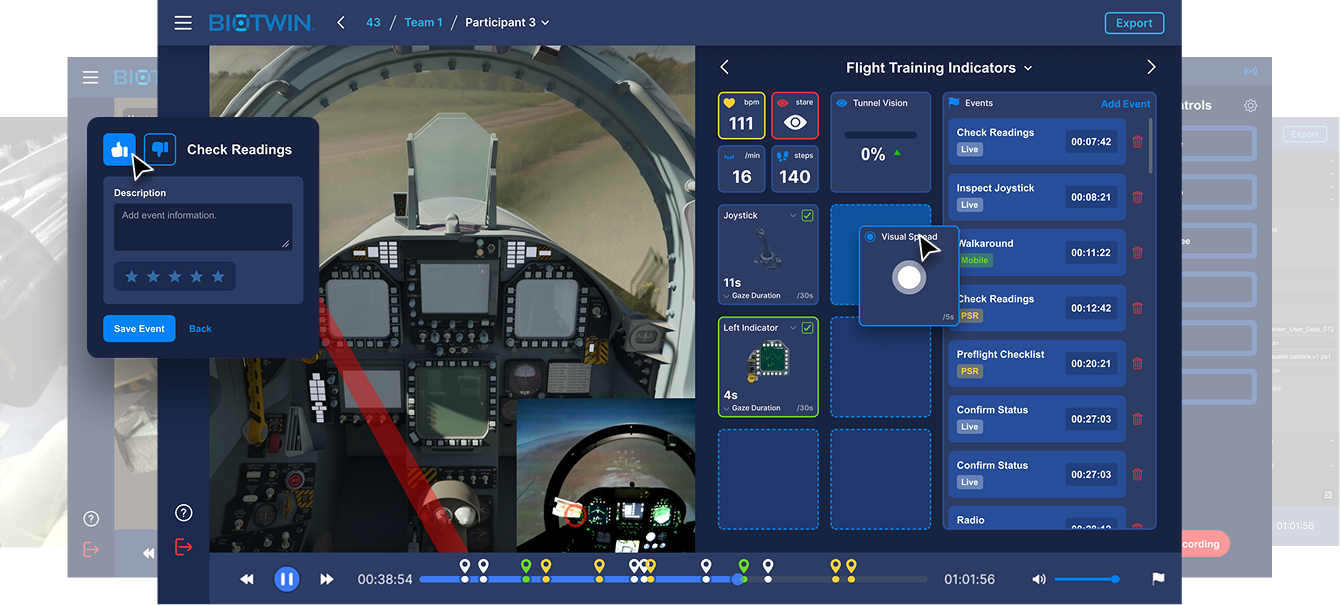
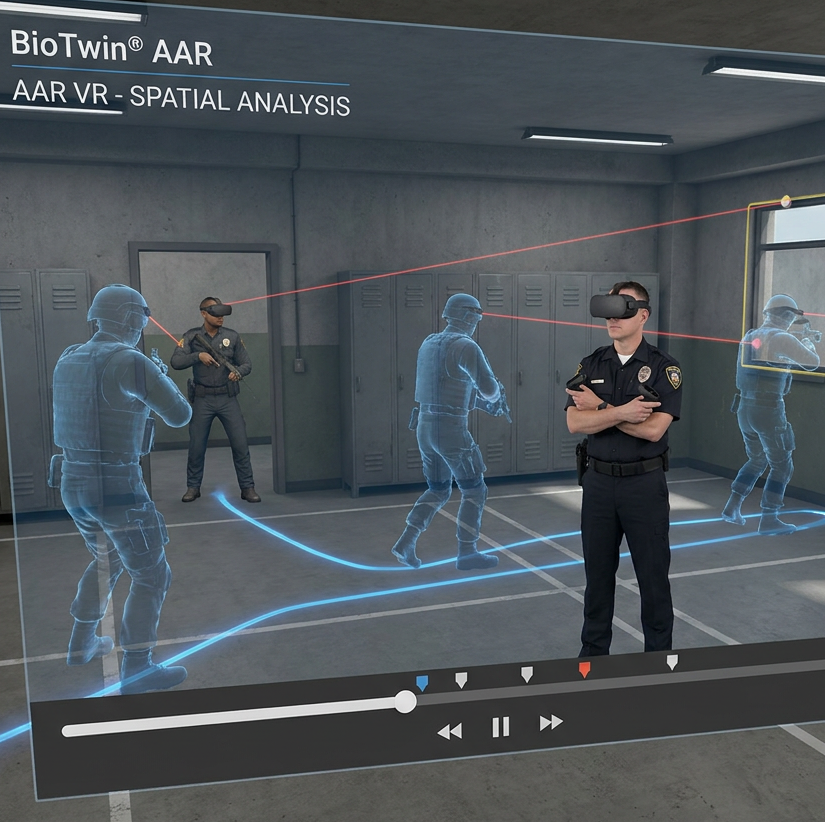
During live sessions, BioTwin® can synchronize first-person scene video, eye-tracking (gaze), behavioural event markers, and optional biometric or motion capture data into a unified training record.
After the session, synchronized replay enables instructors and participants to review performance through time-aligned dashboards. Attention allocation, event timing, and procedural execution can be analyzed with clarity rather than recollection.
The purpose is not automation, but it is evidence.
Instructor judgment remains central. BioTwin® strengthens it by replacing assumption with synchronized behavioural insight.
Optimizing Time in Training
Training leaders are often pressured to increase throughput while maintaining safety and compliance standards. The answer is not reducing exposure. It is accelerating understanding.
When behavioural data is synchronized and replayable, debriefs become focused. Critical moments can be isolated quickly. Missed visual confirmations are identifiable. Patterns across repeated runs become measurable.
Time is no longer spent reconciling memory. It is spent refining performance. Optimizing “time in training” means increasing clarity per session — not cutting repetitions.
Closing the Behavioural Gap
The real cost of subjective training is not inefficiency. It is variability and hidden risk.
BioTwin® provides a modular, offline-first human-performance platform that makes behavioural execution visible, synchronized, and reviewable — without disrupting existing training, inspection, or command ecosystems.
By making attention, timing, and procedural adherence measurable, organizations can:
- Improve assessment consistency
- Reduce documentation burden
- Strengthen compliance validation
- Enable reflective learning
- Enhance readiness transparency
Most importantly, they can make training measurably safer.
Because in mission-critical environments, safety is not defined only by what was completed — but by how it was executed.