In mission-critical environments, training time is limited. Operational schedules are tight, equipment availability is often constrained, and instructors must balance multiple teams and training cycles. Across defence operations, emergency response units, aviation maintenance, and industrial safety programs, the pressure to increase efficiency in training is constant.
The challenge is that efficiency cannot come at the cost of readiness. Reducing repetitions or shortening exercises may create the appearance of efficiency, but it rarely improves performance. In complex environments, skill development still requires repetition, experience, and reflection.
The real opportunity lies in improving how quickly training sessions can be understood and acted upon.
The Cost of Ambiguity in Training
Training exercises generate a significant amount of information. Operators perform tasks, instructors observe behaviour, and teams respond to evolving scenarios. Once the exercise ends, much of that information becomes difficult to reconstruct with precision.
Instructors rely on notes and recollection to piece together events, while trainees attempt to recall what they saw and why decisions were made. Discussions often focus on outcomes rather than the behaviours that led to them.
This ambiguity slows learning cycles and extends the time required to reach clear conclusions.
From Reconstruction to Replay
One of the most effective ways to improve training efficiency is to reduce the time spent reconstructing what happened during an exercise. In many environments, instructors and trainees rely on notes and recollection to piece together how events unfolded. That process can consume valuable time before meaningful learning begins.
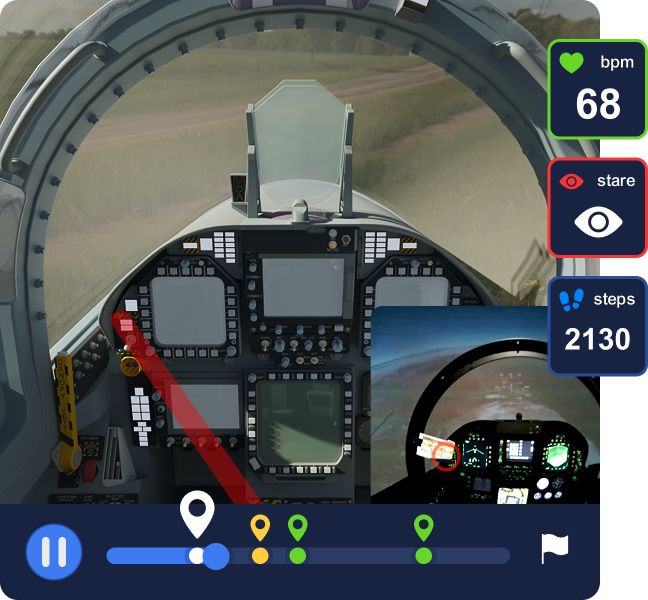
Platforms such as BioTwin® enable training sessions to be captured and reviewed through time-synchronized playback, aligning first-person video, gaze overlay, and instructor event flags within a single timeline.
When sessions can be reviewed this way, the sequence of actions becomes easier to understand. Instructors and trainees can see how attention shifted, when decisions occurred, and how actions aligned with the scenario. What changes is how quickly teams move from observation to understanding.
Accelerating Debrief Cycles
Debrief sessions are one of the most important components of effective training. They allow instructors to translate experience into learning and give participants an opportunity to reflect on performance. However, traditional debriefs often require time to reconstruct the sequence of events before meaningful discussion can begin.
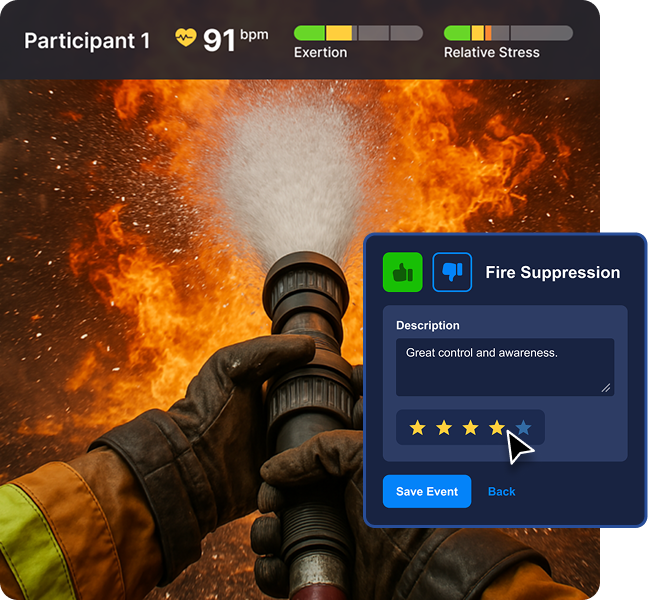
With BioTwin’s Live Console and Post Session Replay workflow, instructors can revisit specific moments immediately, without relying on memory or fragmented not. Time-aligned replay allows instructors to isolate critical points in the exercise and examine them directly. Gaze overlay and event markers provide insight into what participants were focusing on, while optional biometric data can help contextualize workload.
Instead of debating what happened, debriefs can focus on why it happened and how performance can improve.
Reducing Remediation Ambiguity
Ambiguity during review can also affect how remediation is delivered.
When behavioural data can be synchronized and replayed, remediation becomes more targeted. Instructors can point directly to the moment where attention shifted away from a critical component or where a procedural step occurred earlier or later than intended.
Participants can see these moments themselves, which accelerates understanding and reinforces learning. This reduces uncertainty in feedback and shortens the time required to correct performance across repeated exercises.
Efficiency Through Clarity
In high-risk environments, reducing exposure to training rarely produces better outcomes. Complex skills still require repetition, practice, and deliberate instruction. The real efficiency comes from clarity.
When instructors and trainees can review synchronized behavioural evidence, learning cycles become shorter and more precise. Debriefs become more productive, remediation becomes more focused, and performance trends become easier to track across sessions. Platforms like BioTwin® support this by structuring behavioural data into a unified timeline, allowing instructors to quickly interpret performance and apply consistent evaluation across training cycles.
Exercises remain rigorous, but the time required to interpret and learn from them becomes significantly shorter.
In mission-critical training environments, efficiency is not achieved by doing less training — it is achieved by learning more from every session.