
Experience is one of the most valuable assets in policing.
It helps officers assess situations quickly, identify risks, and make decisions under pressure. Years of patrol work, investigations, and incident response create pattern recognition that allows experienced officers to process information faster than new recruits.
But experience can also change how information is perceived.
As officers encounter similar calls, familiar environments, and repeated scenarios, the brain naturally begins relying on expectation and prior experience to fill gaps. Most of the time, this improves efficiency. Sometimes, it creates blind spots.
Experience reduces uncertainty — until it hides it.
When Familiarity Replaces Observation
Every police officer develops mental shortcuts over time.
A veteran officer responding to a disturbance call may immediately recognize familiar patterns. An experienced investigator may quickly focus on evidence that aligns with previous cases. A seasoned patrol officer may enter a situation believing they already understand what they are about to encounter.
The challenge is that real-world situations rarely unfold exactly as expected.
When assumptions begin replacing active observation, officers can become vulnerable to:
- cognitive tunneling
- assumption bias
- overconfidence
- pattern fixation
- missed environmental cues
The issue is not a lack of competence. In many cases, these blind spots emerge precisely because officers are highly experienced.
The Hidden Cost of Experience
In policing, small details often matter.
A missed visual cue during a search. An overlooked individual in a crowded environment. A critical piece of information that falls outside an officer’s immediate focus.
These are not necessarily failures of training. They are natural human limitations that can emerge when familiarity narrows attention.
Traditional training often evaluates outcomes: Was the suspect located? Was the scene cleared? Was the investigation completed?
What is harder to evaluate is how attention was allocated throughout the process.
Understanding where officers focus, what they observe, and what they miss can provide valuable insight into performance that outcomes alone cannot reveal.
Making Attention Visible
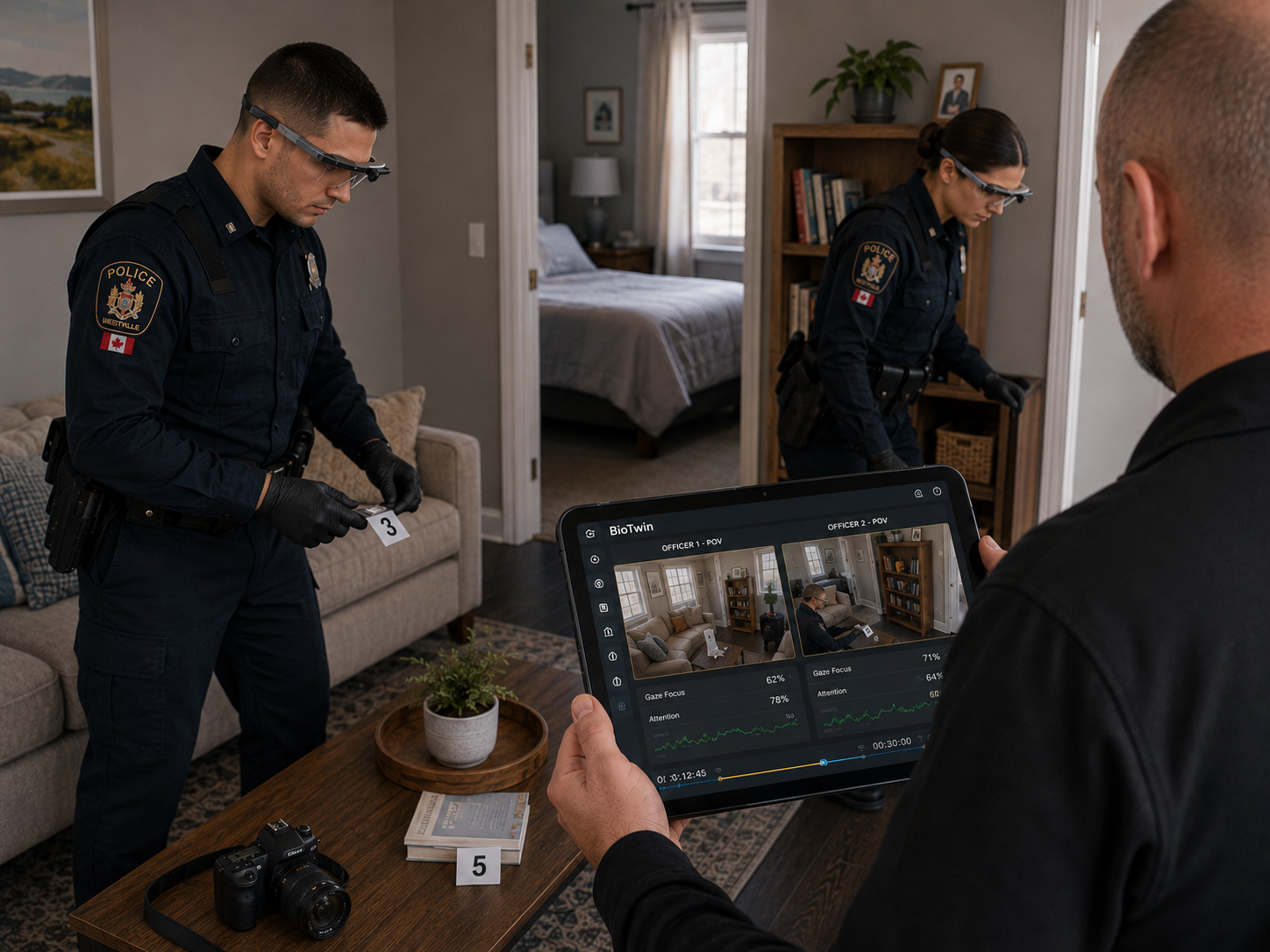
BioTwin® supports evidence-based police training by synchronizing first-person video, gaze tracking, event markers, and optional biometric data into a single review workflow.
This allows instructors to revisit training scenarios and examine how officers interacted with their environment during an exercise.
Rather than focusing solely on whether the objective was achieved, instructors can review:
- attention allocation
- visual scanning patterns
- environmental awareness
- decision timing
- procedural execution
The objective is not to replace experience.
It is to help experienced officers remain aware of the blind spots that familiarity can create.
Experience Still Requires Verification
Experienced officers remain the backbone of every police service.
Their judgment, leadership, and operational knowledge are essential. But expertise does not eliminate human limitations.
As policing environments become increasingly complex, training programs must look beyond outcomes alone and examine how performance unfolds under realistic conditions.
Because in policing, the most challenging blind spots are often not caused by inexperience.
They are created by the confidence that comes with experience itself.

