The most important work in policing is often the least visible.
Not the arrest itself.
Not the incident report.
Not the response outcome.
But the constant cognitive effort required to keep situations stable before they escalate.
Modern Policing Is Increasingly Cognitive
Police work has always involved pressure, uncertainty, and rapid decision-making. But modern policing also demands continuous mental processing that often goes unnoticed.
An officer managing radio traffic while assessing body language during a volatile interaction.
A supervisor tracking multiple units across a rapidly evolving scene.
A team maintaining situational awareness while balancing communication, public safety, and operational procedure simultaneously.
Much of this work leaves no visible trace.
Yet it consumes attention continuously.
Organizations Measure Outcomes — Not Mental Load
Most operational metrics focus on visible results:
- Was the suspect apprehended?
- Was force avoided?
- Was response time acceptable?
These measurements matter, but they reveal very little about the hidden strain carried by officers throughout an operation.
Mental fatigue builds gradually.
Attention narrows.
Situational awareness begins to drift.
Decision quality becomes harder to sustain over time.
In many cases, these effects remain invisible until performance begins to degrade.
The Burden of Constant Readiness
One of the least discussed aspects of policing is monitoring fatigue.
Officers are expected to remain alert even when nothing appears to be happening. They continuously scan environments, interpret weak signals, assess risk, and anticipate escalation before it occurs.
This type of work rarely appears in traditional evaluations because externally, the scene may still look calm.
Internally, however, cognitive load may already be building across the team.
The absence of visible action does not mean the absence of operational strain.
Making Invisible Work Measurable
A growing number of agencies are beginning to recognize that operational readiness depends not only on training and procedures, but also on understanding the hidden demands placed on officers during dynamic situations.
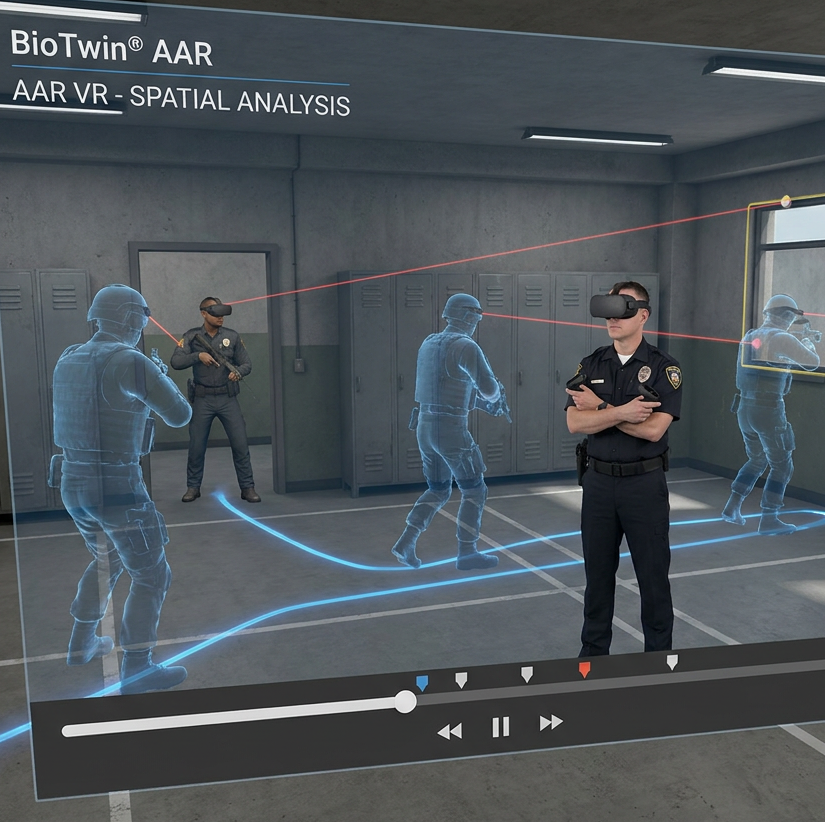
New human performance technologies like BioTwin are helping make this invisible layer measurable by providing insight into cognitive load, stress propagation, attention patterns, and team dynamics during training and live operational exercises.
Not simply to evaluate individual officers, but to better understand how policing teams function collectively under sustained pressure.
Because in modern policing, the work that matters most is often the work no one sees.